Why Switching Power Supplies (SMPS) Are Essential for Modern Electronics and LED Lighting
(Primary keywords: switching power supply, SMPS, LED driver, power supply efficiency, linear power supply vs SMPS)
Modern electronic devices — computers, power adapters, and especially LED lighting systems — almost universally rely on switching power supplies (SMPS). The reason is simple: higher energy efficiency, smaller size, and lower heat losses compared to traditional linear power supplies.
Traditional (Linear) Power Supplies: Inefficient by Design
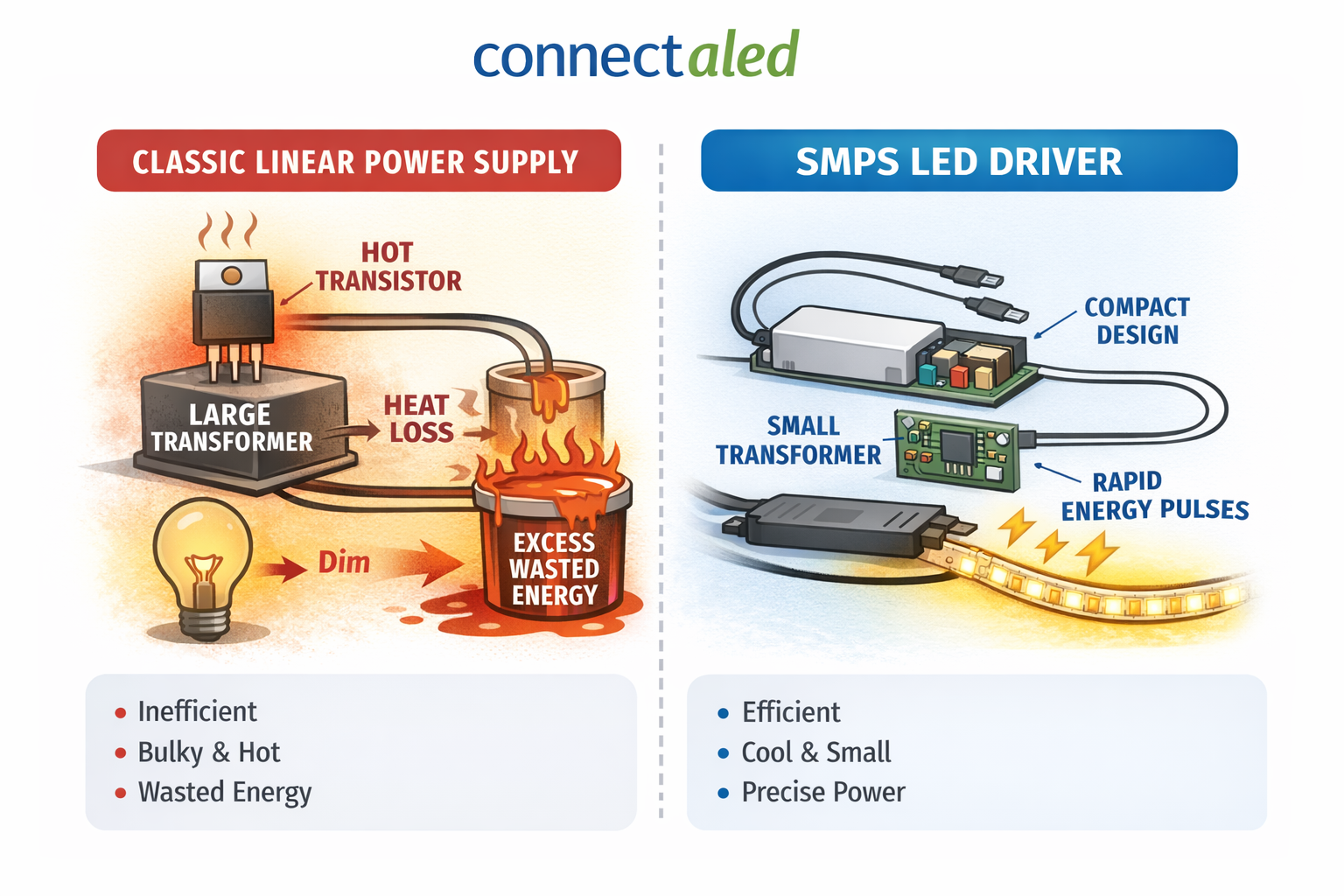
A linear power supply works by first reducing voltage and then removing excess energy through analog regulation, usually with a transistor.
That extra energy doesn’t disappear — it is converted directly into heat.
- low efficiency
- high thermal losses
- large transformers and heat sinks
- bulky and heavy power supplies
For modern electronics and LED systems, this approach is no longer practical.
How Switching Power Supplies (SMPS) Improve Efficiency
A switching power supply does not waste energy by burning it off.
Instead, it:
- switches energy on and off at high frequency
- typically 30 kHz to 150 kHz
- transfers energy in small, precisely controlled packets
These packets are delivered tens of thousands of times per second, providing exactly the amount of power required by the load.
- very high efficiency (often >90%)
- minimal heat generation
- much smaller magnetic components
- compact and lightweight designs
Why SMPS Technology Is Ideal for LED Drivers
LEDs are current-controlled devices, which means they require:
- precise current regulation
- stable power delivery
- minimal heat inside the driver
This is exactly what SMPS-based LED drivers provide.
A modern LED driver:
- regulates current, not just voltage
- keeps efficiency high and losses low
- protects LEDs from overcurrent
- allows compact luminaires and LED strips
- supports dimming, PWM, and CCT control
Without SMPS technology, high-efficiency LED lighting would not be possible.
LED Driver Principle (Simple Block Explanation)
How it works (simplified):
- AC or DC input is rectified
- High-frequency switching controls energy flow
- A small transformer or inductor transfers energy
- A feedback loop keeps LED current stable
This allows precise energy delivery with minimal losses.
Simple Analogies: Water & Trains
Water analogy
A linear supply is like pumping too much water and dumping the excess through an overflow. An SMPS delivers only what is needed, drop by drop, very fast — no waste.
Train analogy
A linear supply sends one oversized wagon and throws away unused cargo. An SMPS sends many small wagons, at high speed, each carrying just the right amount of energy.
Linear Power Supply vs SMPS (Quick Comparison)
| Feature | Linear Power Supply | Switching Power Supply (SMPS) |
|---|---|---|
| Efficiency | Low (40–60%) | High (80–95%+) |
| Heat generation | High | Low |
| Transformer size | Large | Small |
| Overall size | Bulky | Compact |
| Weight | Heavy | Light |
| Energy waste | Excess burned as heat | Minimal |
| LED driver suitability | Poor | Excellent |
| Dimming & control | Limited | Advanced (PWM, CCT) |
Why SMPS Dominates Modern Electronics
By transferring energy only when needed and only in the required amount, switching power supplies achieve:
- higher efficiency
- lower operating temperatures
- smaller physical size
- longer component lifetime
This is why SMPS is the backbone of modern electronics and LED lighting systems.