Instead of a positive feedback, when an increase in ambient temperature leads to an even higher temperature and leads to accelerated aging of the belt, we have created a negative feedback. In the LED strip segment, we have also added a special integrated circuit that absorbs these changes and always maintains the current through the LEDs to the projected value. Whatever happens to the supply voltage, ambient temperature, resistance change R, the integrated circuit IC always takes the changes on itself and all other elements of the LED strip remain at their designed optimal values. That’s why we at ESTI say that each of our LEDs is protected and very durable.
This is also important when choosing the power supply of the LED strip. Since there are power supplies for LED strips on the market with non-guaranteed characteristics, especially in the output voltage part, this circuit takes on such changes. On the other hand, there is no such thing as a 12V (or 24V) LED strip power supply. Sometimes it is smaller and sometimes larger. When it is lower you will not have the expected value of illumination, and when it is higher you will come to the risk of accelerated aging of the LED strip. This ESTA LED strip solution solves this situation as well, as it takes on these differences and… Again, it gives the LED strip exactly the required current.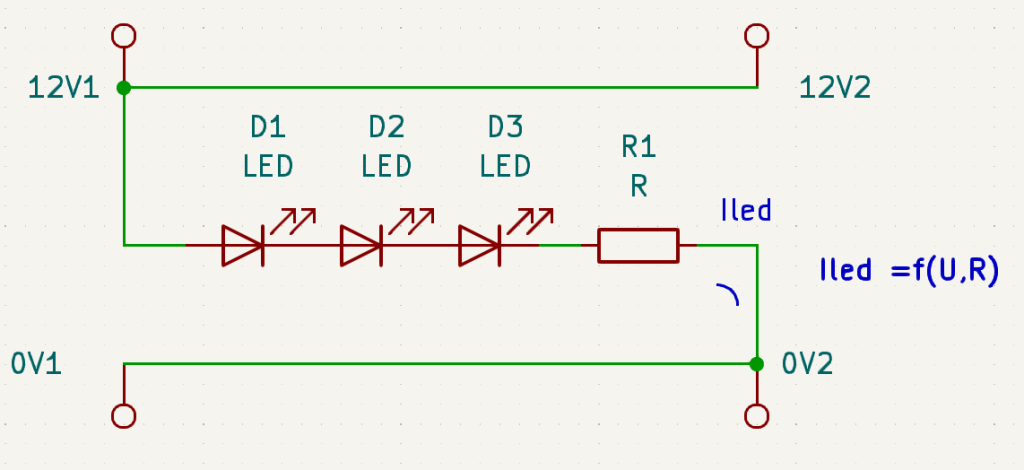
How We Protected Every LED in the Strip – Why ESTA LED Strip Is Permanent
In the picture above you can see the classic solution (schematically shown) of one segment of the LED strip. The tape is made up of a series of such segments. Physically, on the strip, they are depicted by a line indicating the place where the strip can be cut to the required length. There is also a 12V DC power supply. There are also strips on sale that work at other voltages, e.g. 5V, 24V… The essence of the solution that we want to clarify here is that the current through the array of LEDs is limited by a resistor that limits it to the nominal current of the LED, i.e. the amount of electricity that the LED manufacturer allows. Depending on the type of LED, this current can be 20mA, 60mA, 100mA and… The designer of the LED strip must adapt this segment, diodes and currents to the characteristics of the LED diode if he wants to extract the most efficient and durable strip. More than 90% of the tapes are made according to this principle. What are the potential problems with such a solution? When designing the belt, the temperature of the environment in which the belt will operate is also taken into account. At this (imaginary temperature) the tape works completely as expected. In the event of a change (e.g. increase in ambient temperature), the electrical resistance of resistor R1 decreases (this is its characteristic). the current of the LEDs is automatically increased. Furthermore, as the current of the LEDs increases, their operating point changes, their internal resistance decreases and the current increases further. Such a development of the situation is potentially bad for the durability of the tape because by increasing the current through the shown circuit, an additional temperature is emitted, and it further carries an additional increase in current — then again the temperature and finally to the burnout of the tape elements. Essentially, we have a positive feedback loop, and this situation (which is not uncommon) is called accelerated tape aging.