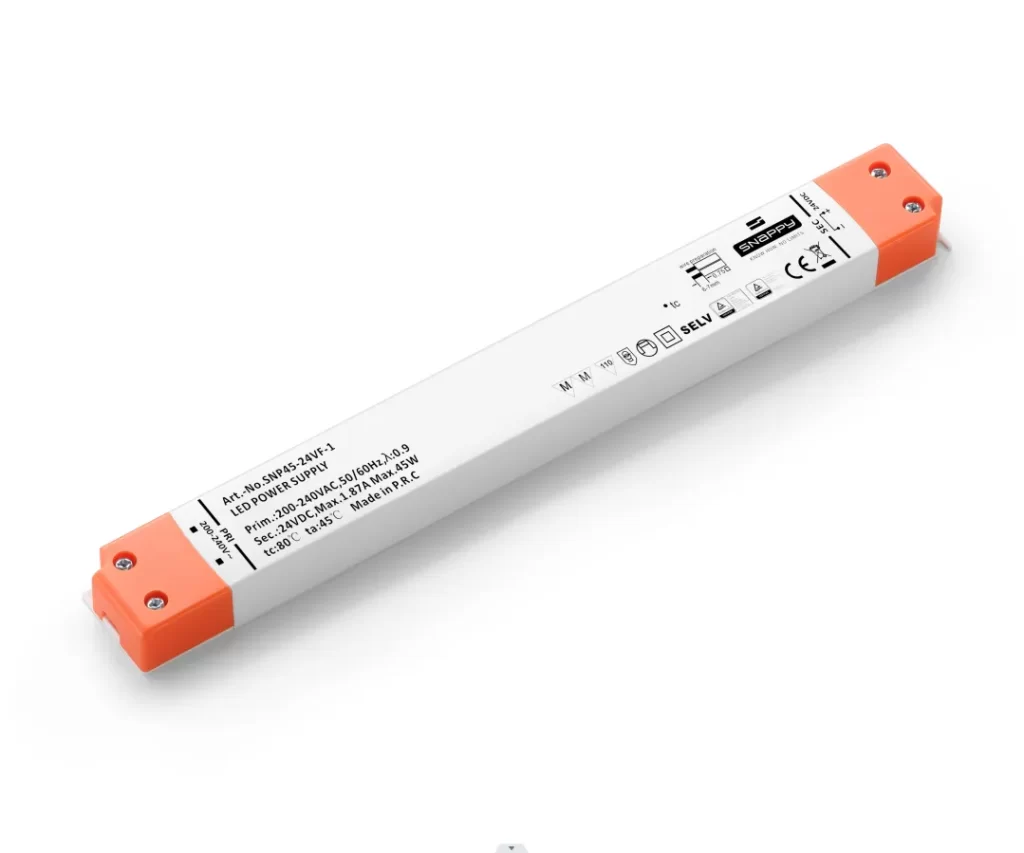
When you decide to install LED strips in your space, whether it’s decorative lighting in the living room, ambient lighting in the kitchen, or functional lighting in a workspace, one of the most important steps is choosing the right power supply for LED strips. A proper power supply ensures that your strips function efficiently, safely, and last a long time.
In this blog, we will explain the key factors you need to consider when selecting a power supply, so you can be sure you’ve made the right choice for your LED strips.
1. Understanding Basic Concepts
Before we go into details, it’s important to understand the basic concepts related to powering LED strips:
- Volts (V): LED strips usually come in 12V or 24V versions. It’s important to choose a power supply that matches the voltage of your LED strips.
- Watts (W): The total power of the power supply is measured in watts and determines how much electrical energy the strip uses. This is crucial for proper power supply selection.
- Amps (A): This unit shows the current flow. Choosing the right power supply that can provide enough amps is important for stable operation of the strips.
2. Calculate the Required Power (Watts)
One of the key factors in choosing a power supply is calculating the required power of your LED strips. Here’s a simple way to do it:
- Find the consumption per meter: On the packaging or technical documentation of the LED strip, you will usually find the power per meter (e.g., 4.8W/m, 9.6W/m, or 14.4W/m).
- Multiply the power per meter by the strip length: For example, if your strip consumes 9.6W/m and you plan to install 5 meters of strip, you need a power supply that can provide a total of 9.6W/m x 5m = 48W.
- Add a safety margin: To ensure longevity and stability of the power supply, it’s recommended to add a 20% safety margin. In this case, that would mean: 48W x 1.2 = 57.6W. So, for this installation you need a power supply of at least 58W.
3. Choosing the Right Voltage (12V or 24V)
LED strips most commonly come in 12V and 24V versions. The key is that the power supply you buy matches the voltage of your strips. If you have a 12V LED strip, you must use a 12V power supply. The same applies to 24V LED strips.
- 12V strips: Most commonly used for shorter installations or decorative lighting.
- 24V strips: Better for longer installations as they allow less voltage drop over longer distances, thus avoiding light dimming at the ends of the strip.
4. Types of Power Supplies
There are several types of power supplies you can use for LED strips:
a) Standard power supply
These are the most commonly used power supplies for LED strips and are available in various power ratings. They can be in plastic or metal housing, and are designed for indoor use. They are ideal for installations in homes or business premises.
b) Waterproof power supply
If you plan to place LED strips in outdoor locations or in areas with high humidity (such as kitchens or bathrooms), a waterproof power supply is essential. These power supplies are usually coated with a protective layer and have an IP65 or IP67 rating, making them resistant to moisture and dust.
c) Dimmable power supply
If you want the ability to control the brightness of your strips, you can choose a dimmable power supply. This power supply allows you to connect the strips to a dimmer switch or smart lighting systems for additional light control.
5. LED Controllers for RGB Strips
If you use RGB LED strips, besides the power supply, you also need an LED controller. This device enables color changes, light intensity, and various lighting effects. Also, the LED controller must be compatible with the power supply you use. It’s important to note that the power supply must provide sufficient power for both the LED strips and the controller.
6. Proper Installation of the Power Supply
When installing the power supply for LED strips, pay attention to the following:
- Proper ventilation: Power supplies heat up during operation, so it’s important to ensure good ventilation to prevent overheating.
- Location of the power supply: Place the power supply in a dry location, away from sources of moisture or extreme temperatures.
- Cable length: Make sure cables are long enough to avoid excessive tension or bending.
7. Power Supply for Longer LED Strip Installations
If you plan an installation longer than 5 meters, you might need multiple power supplies or the use of additional cables for voltage drop mitigation. When LED strips are placed over long distances, there can be a reduction in brightness at the ends of the strip. 24V LED strips are a better choice for longer installations as they handle voltage drop better compared to 12V strips.
Conclusion
A properly chosen power supply is key to the long-term and efficient operation of your LED strips. When selecting a power supply, pay attention to the power (watts), voltage (12V or 24V), as well as the specific needs of your space, such as waterproofing or light regulation capabilities.
If you’re not sure which power supply is best for your LED strips, you can always consult experts or contact the seller to get recommendations that suit your specific needs.
Follow our blog for additional tips and guides on LED lighting, and don’t forget to visit our selection of ESTA LED strips and corresponding power supplies to ensure long-lasting and quality operation of your lighting systems!