Importance of Copper Layer in LED Strips
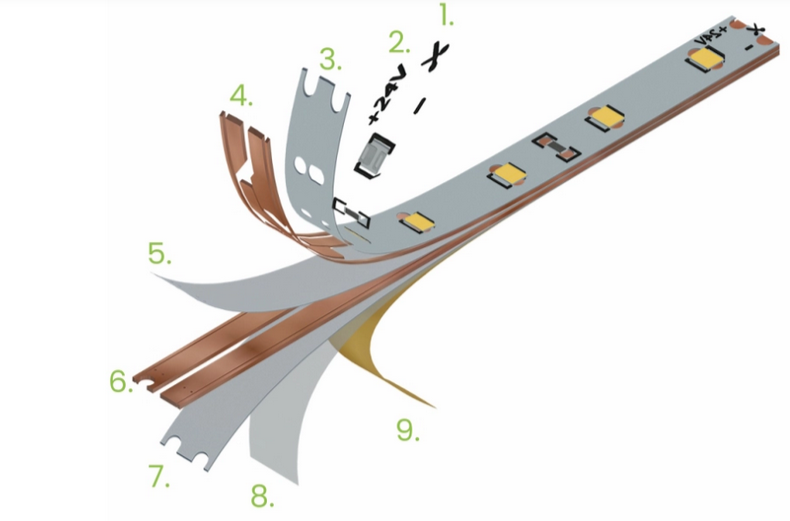
PCB Structure (Double-Sided Mounted Copper Strips)
In combination with the picture above, understanding will be easy. The first layer is used to place electrical components, such as LEDs and resistors. The second layer is screen printing, also known as “label printing”. Some logos, such as UL icon, power supply voltage, necessary markings, are printed on this layer. The eighth layer is the adhesive for the substrate, and the ninth layer is the release paper used to maintain the stickiness of the background adhesive. The third and seventh layers are protective films. It protects the surface of the copper from oxidation and maintains the arrangement of the circuit. This PI film has different types of colors, such as white, yellow, black. Widely used white can maximize the reflectivity of the lighting emitted by LEDs. The fifth layer is the substrate, which provides a physical, structural basis for the LED strip, does not allow electricity to pass through its electronics, and provides a key pathway for heat dissipation. The substrate material is mainly PI. The fourth and sixth are copper layers, which are aimed at conducting electricity. As a rule, the impact of these two layers of copper on LED strips is enormous, mainly due to their width and thickness. In most cases, to achieve higher quality, the thickness of the copper must be significant. In all the layers, the most significant layer is the copper layer whose width and thickness will directly affect the properties of the PCB, and therefore affect the quality and lifespan of the LED strips. The thickness of the copper applied varies from manufacturer to manufacturer and ranges from 0.017 mm to 0.035; 0.70 to 0.105 mm, and in some cases a little more, but not more than 0.13 mm. In the English-speaking world, the term ouz is used, and translated into our measurements, 1 ouz = 0.035mm thick. (1 oz means the thickness of the copper that evenly covers 1 square meter.) So, if you intend to choose high-end LED strips, choosing copper LED strip as one of the raw materials is of great importance. From two perspectives, thickness and width: Thickness For LED strips, thicker copper is better if other conditions are equal. The reasons are as follows: Thicker copper allows for higher current, less resistance, and greater heat dissipation, which makes the voltage drop smaller. The overall efficiency, durability of the tape and the length of the tape spread is greater. Inadequate copper thickness will cause an increase in resistance, heat accumulation, voltage decrease, and even premature failure of the LED strip. A frequently seen phenomenon that we call “accelerated aging of the tape”. You will probably see it in a lot of places, if you take a closer look at LED strips in shop windows, appliances, facades… You will see that the strip parts do not light up. This is one of the possible reasons … I.e., one of the most common. ESTA LED strips use a copper thickness of 0.105 (3 ouz) and above and are among the highest quality. Width: The width of the strip depends on the ability of the designer and manufacturer of the strip to use the full width of the strip to lay the copper layer. E.g. if the width of the LED strip is 10mm then the width of the copper (for single-color LED strips) should be slightly larger than 4mm. Both conditions (strip thickness and width) are met in ESTA LED strips.